Is Online Learning the Great Equalizer?
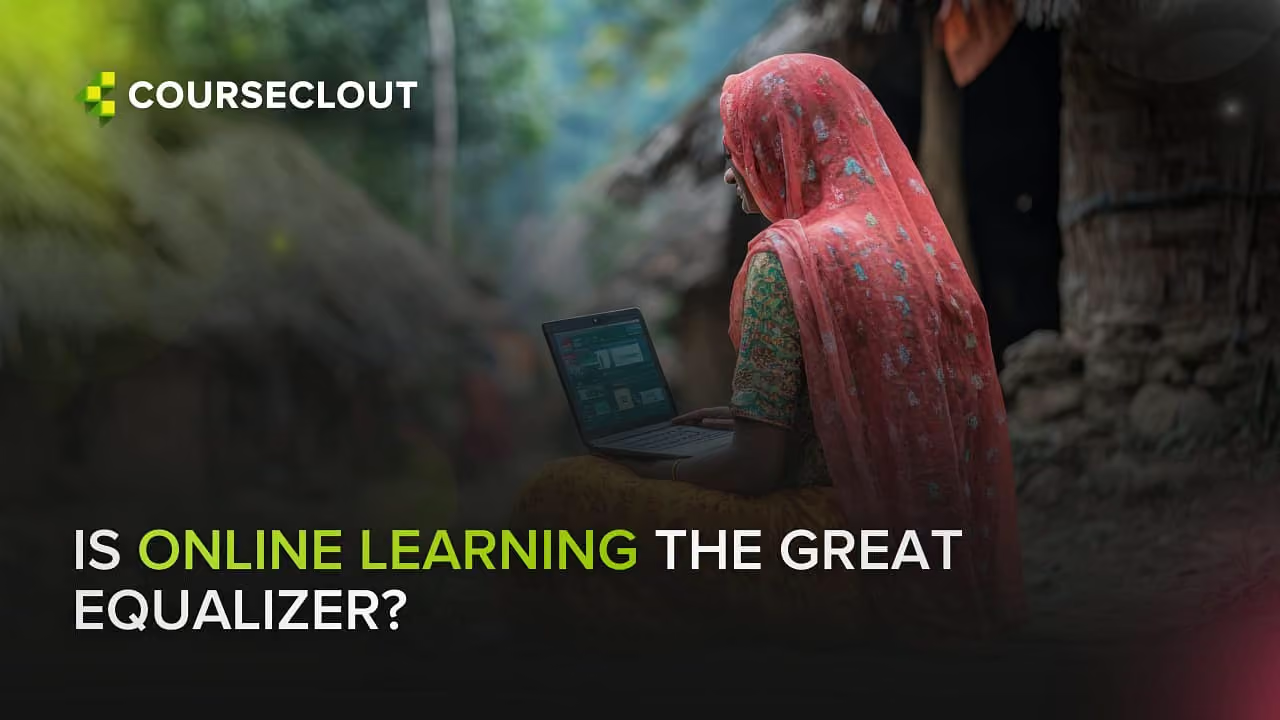
In the digital age, education is no longer confined to traditional classrooms. Online learning has emerged as a powerful tool for individuals seeking to advance their careers, acquire new skills, and broaden their horizons. With over 1.1 million students enrolled in online colleges in the United States alone, according to Forbes Advisor, online learning is rapidly gaining popularity and accessibility.
As the e-learning market continues to grow at a substantial rate, projected to reach 20.5% between 2022 and 2030, online learning is poised to become an even more integral part of the educational landscape. By breaking down barriers of affordability, accessibility, and flexibility, online learning has the potential to democratize education and provide opportunities for learners from diverse backgrounds.
This article explores whether online learning truly is the great equalizer, examining its impact on education, career advancement, and social equity.
Affordability
Online learning can break down barriers in affordability for learners from lower socioeconomic backgrounds. This leads us to look primarily at cost comparison and financial aid opportunities.
First of all, online learning is significantly more affordable. The Education Data Initiative shows that out-of-state tuition rates are considerably lower for online than in-person learning. For example, an online degree with a private institution costs an average of $62,756 as opposed to $198,616 for an in-person degree. They also highlight that beyond tuition and fees, the cost per credit hour remains much lower for online programmes than in-person both in public ($321 online vs $729 in-person) and private institutions ($505 online vs $1598 in-person).
Second, financial aid for online learning is getting more attention and consideration. No longer confined to traditional education, financial aid such as scholarships, loans, and work study opportunities are now increasingly being made available for online learning opportunities. However, It’s not yet clear if financial aid is for online college education or for non-formal education as well.
Accessibility
Online learning can also overcome geographic limitations by allowing remote access to educational opportunities for underserved areas. According to PPI, in the US online learning can help reach learners in rural communities, citing that 41% of Americans in urban areas have a college degree as opposed to 28% of Americans in rural areas. This difference in access to higher education opportunities means that rural Americans are less likely to have the same high-paying job opportunities, which strengthens the case for online education as a solution to this digital divide.
Statistics from Coursera also show that online learning is booming among middle and lower-income countries. While the US is in first place with the highest number of online learners (followed by India, Mexico, Brazil and China), the highest growth is found in emerging economies. Paraguay leads in first place, seeing a 98% increase in online learners between 2016 and 2022, followed by Lebanon, Philippines, Guyana, Indonesia, Kenya, Ethiopia, Rwanda, Viet Nam and Kazakhstan. This shows how online learning goes beyond borders by removing the need for travel or visas to be able to learn from leading institutions and industry leaders.
Flexibility
Online learning offers unparalleled flexibility and convenience. This is particularly valuable for learners with busy schedules or unique learning styles, increasing the reach to those balancing study with work or those with family responsibilities. According to Online Education, research shows that half of learners enrolled in online programmes are married with children under the age of 18, while almost 40% of undergraduates and 60% of postgraduates in online programmes work full time.
According to Coursera, online learning removes the choice that traditionally had to be made between working while studying, therefore reaching more people and creating more opportunities than in-person opportunities.
Beyond accommodating for busy schedules, online learning offers self-paced options, which is particularly beneficial for those who need more time to grasp complex concepts, or need more of a hands-on approach. This approach is especially well suited to those with learning disabilities and special needs, allowing them to progress at their own pace and based on their needs.
More generally, online learning removes the need for commuting, which saves learners valuable time or the need for transport. This has implications both in terms of cost, but also in terms of mobility for people with physical disabilities with research showing that online learning provides them with more independence and opportunities for social interaction.
Quality
As the world faces a learning crisis and the job market is disrupted with the need for new skills, online learning has proven to be a viable and effective alternative to traditional education.
Accredited online programmes are now provided by world-renowned institutions and industry leaders, ensuring international standards. Coursera alone offers over 7,000 courses where you can study with the University of London, Penn State or HEC Paris, or companies like Google or IBM.
Furthermore, online courses often feature experienced faculty members with expertise in their respective fields. Peer review processes and quality assurance also help maintain the quality of course content and instructional design.
A recent survey by Jsic, a non-profit in the UK, found that among 27,000 UK university students, 81% were satisfied with their online learning experience which shows a significant increase post pandemic. This shows that online learning can provide a fulfilling and effective learning experience and environment.
Career Advancement
In today’s rapidly changing job market, online learning has enormous potential to empower people to both advance and transform their careers. According to the World Economic Forum’s 2023 Future of Jobs report, “44% of skills will be disrupted in the next five years”.
This is all the more important as technological advancement has led to a rapid change in skill development.
By learning new skills on an ongoing basis, especially through non-formal adult education programmes, online learners can adapt to these changing demands and unlock new career opportunities. According to Coursera’s 2023 Learning Outcomes report, 77% of learners have benefitted from a new job, a promotion or gaining new skills, with that figure rising to 91% in developing economies.
In addition to career advancement, online learning can also facilitate career transition by helping people who are looking to pivot or transition to a new career to match demand in emerging fields. For example those working in traditional industries can upstill in digital marketing or data analysis to remain competitive to the job market. A 2021 poll already showed that 52% of Americans were considering a job change, indicating that the need for reskilling and upskilling through both formal and informal online courses will continue to grow.
A Catalyst for Change
Online learning has the potential to revolutionize education and create a more equitable world. By breaking down barriers of affordability, accessibility, and flexibility, online learning empowers individuals from diverse backgrounds to access quality education, advance their careers, and improve their financial prospects.
CourseClout is at the forefront of this transformative movement. With our expertise in creating engaging and effective online courses, we can help organizations unlock the full potential of product education. By partnering with CourseClout, you can:
- Empower your workforce: Equip your employees with the in-demand skills they need to thrive in the digital age.
- Bridge the digital divide: Provide access to quality education for learners from underserved communities.
- Foster innovation and entrepreneurship: Cultivate a culture of continuous learning and empower individuals to pursue their passions.
- Achieve measurable results: Track the impact of your online learning programs and demonstrate their value to stakeholders.
Ready to transform your organization through the power of online learning? Contact CourseClout today to learn more about our online education solutions and how we can help you achieve your goals for maximum impact.